
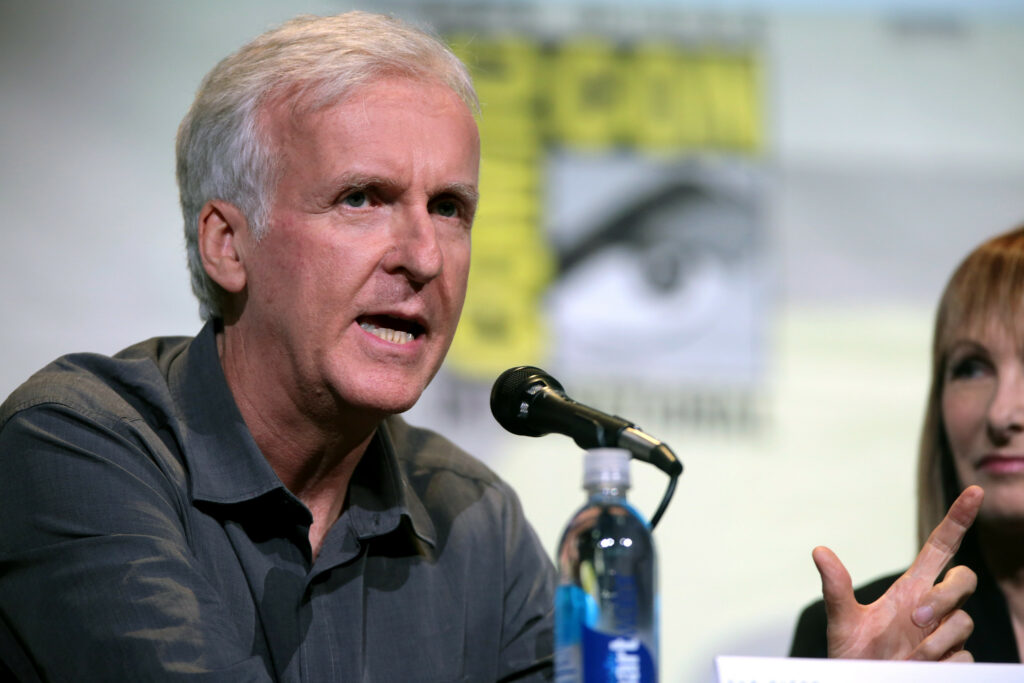
Legendary filmmaker James Cameron took a huge shot at President Donald Trump over his administration’s climate change agenda.
Cameron, the director behind blockbuster franchises including “Terminator” and “Avatar,” used an interview with The Hollywood Reporter about his latest sequel to rant about environmental policy, technological change and the direction of the country under the Trump administration.
His comments included a personal attack on the president as well as warnings about climate policy rollbacks, artificial intelligence and shifting audience behavior in Hollywood.
During the interview, Cameron focused on what he described as a troubling global trajectory tied to environmental decisions coming out of Washington.
James Cameron on Donald Trump: pic.twitter.com/xblgD0uxXY
— Avatar Guy (@Avatar3F) December 17, 2025
He said his concern extends beyond the success or failure of his own films.
“I’m not frustrated that ‘Avatar’ isn’t solving it,” Cameron said. “I’m frustrated because the human race seems to be delusional about what they think is going to happen next. We are going backwards.”
Cameron directed some of his strongest language at President Trump, labeling him the “most narcissistic a—— in history since f—— Nero,” and added, “Yeah, you can quote that.”
Director James Cameron on Donald Trump’s 2nd term: “I think it’s horrific. I think it’s horrifying. I see a turn away from everything decent. I think they’re hollowing it out as fast as they can for their own benefit.” pic.twitter.com/Ab5HdSqZfz
— Marco Foster (@MarcoFoster_) July 30, 2025
The comments arrived as the Trump administration moves forward with sweeping changes to federal environmental and energy policy.
The White House has pushed to scale back climate initiatives, including major funding reductions for green energy projects in states that traditionally support Democratic candidates.
In October, the Department of Energy announced it was canceling awards tied to 223 projects, eliminating roughly $7.56 billion in planned spending.
The funding reductions affected projects spread across multiple blue states.
Ahead of the announcement, White House Office of Management and Budget Director Russell Vought posted on social media that the cuts would target projects in California, Colorado, Connecticut, Delaware, Hawaii, Illinois, Maryland, Minnesota, New Hampshire, New Jersey, New Mexico, New York, Oregon, Vermont and Washington state.
Vought described the canceled initiatives as “Green New Scam funding to fuel the Left’s climate agenda.”
The cancellations have drawn scrutiny from lawmakers who oppose the administration’s approach.
The Department of Energy’s inspector general’s office confirmed it will examine the process behind the funding decisions.
Acting Inspector General Sarah Nelson addressed the matter in a letter shared by Democratic lawmakers who requested the review.
“The Office of Inspector General recently announced an audit which will review the Department of Energy’s processes when cancelling financial assistance and whether those cancellations were in accordance with established criteria,” Nelson wrote.
Nelson’s statement noted that launching the audit does not automatically indicate wrongdoing.
Cameron’s criticism of the administration fit within a broader set of warnings he outlined during the interview, where he linked environmental policy with other developments he believes pose long-term risks.
He questioned whether cultural works like his own films could slow what he sees as accelerating decline.
James Cameron to SS Rajamouli on the use of Generative AI in Cinema:
“It’s Dangerous”
“You could ask it to show you something that looks like Avatar, it could do that now, but it couldn’t do that before 2009”
“We don’t go to movies for mediocrity” pic.twitter.com/cmmyMtLgKZ— Telugu Smash (@SmashTelugu29) December 17, 2025
“Who’s to say we wouldn’t be going backwards even faster if it wasn’t for these films? There isn’t an alternative Earth without ‘Avatar’ we can point to and say, ‘It made this measurable difference,’” Cameron said, adding that he believes his work is on the “right side of history.”
The filmmaker also tied environmental concerns to what he views as growing dangers surrounding artificial intelligence.
Cameron has previously raised alarms about AI’s potential to reshape society and disrupt creative industries.
Only weeks earlier, he said he was “horrified” by the idea that artificial intelligence could generate lifelike digital actors indistinguishable from real performers.
James Cameron tells us the purpose of his film adaptation of ‘GHOSTS OF HIROSHIMA’ will be to remind audiences of the “stark reality of what these weapons do to other people”
“You can forget a lot in 80 years. This is one lesson we can’t forget. We can’t afford to forget” pic.twitter.com/AcmZH6aeXe
— DiscussingFilm (@DiscussingFilm) August 6, 2025
“I’m worried there’s going to be a generation that thinks they could make a movie without an actor,” Cameron said.
He has also spoken publicly about the risks of AI intersecting with military technology.
In an interview earlier this year, Cameron warned that advanced artificial intelligence controlling weapons systems could have catastrophic consequences.
“I do think there’s still a danger of a Terminator-style apocalypse where you put AI together with weapons systems, even up to the level of nuclear weapon systems, nuclear defense counterstrike, all that stuff,” Cameron said.
He expanded on those concerns by laying out what he described as converging global dangers.
“I feel like we’re at this cusp in human development where you’ve got the three existential threats: climate and our overall degradation of the natural world, nuclear weapons, and super-intelligence,” he remarked.
“They’re all sort of manifesting and peaking at the same time.”
Cameron’s commentary came as he promotes his latest release, “Avatar: Fire and Ash,” the third installment in the franchise.
The film continues the storyline centered on humanity’s conflict with the Na’vi, a species portrayed as deeply connected to their environment.
He acknowledged uncertainty about his future involvement with the franchise, suggesting box office performance could influence his next steps.
“Do I want it to be a wild success — which almost compels me to continue and make two more ‘Avatar’ movies? Or do I want it to fail just enough that I can justify doing something else?” Cameron said, describing himself as being at a “crossroads.”
Cameron said that after the current promotional cycle winds down, his focus will shift back to another long-running franchise closely tied to his warnings about artificial intelligence.
“Once the dust clears on Avatar in a couple of months, I’m going to really plunge into that,” he said, referring to “Terminator.”
“There are a lot of narrative problems to solve. The biggest is how do I stay enough ahead of what’s really happening to make it science fiction?”
He confirmed that franchise mainstay Arnold Schwarzenegger will not appear in the next installment.
“I can safely say he won’t be [in it],” Cameron said. “It’s time for a new generation of characters. I insisted Arnold had to be involved in Terminator: Dark Fate, and it was a great finish to him playing the T-800.”
“There needs to be a broader interpretation of Terminator and the idea of a time war and super intelligence. I want to do new stuff that people aren’t imagining.”
Schwarzenegger, now 78, remains the only actor to have appeared in all six Terminator films.
Cameron last directed the franchise with “Terminator 2: Judgment Day” and later returned as a producer on “Terminator: Dark Fate.”
In 2022, he said another reboot was under discussion, though no final decisions had been announced.