
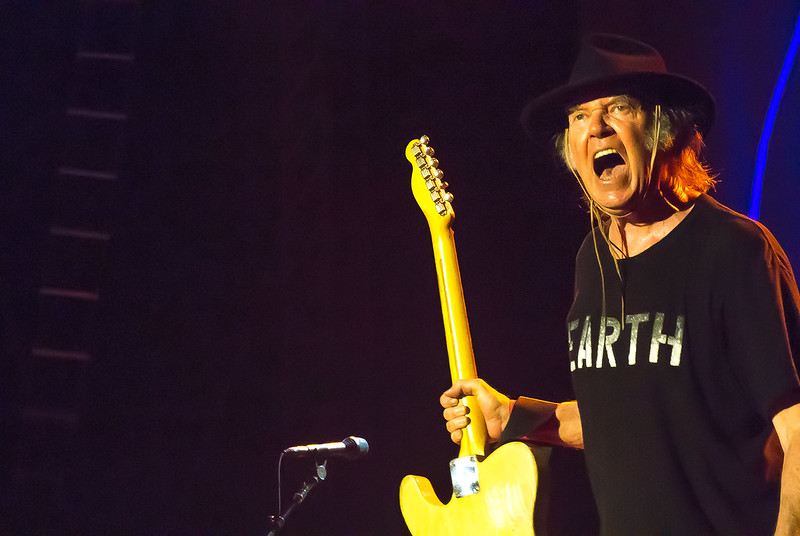
The 80-year-old far-left rocker announced he is giving Greenlanders a free year of access to his entire music catalog, framing the move as a response to what he described as growing pressure tied to Trump’s interest in acquiring the Arctic territory.
“I’m honored to give a free year’s access to neilyoungarchives.com to all of our friends in Greenland,” Young announced in a post published Tuesday on his website.
Young directly tied the giveaway to the current administration, writing that he hoped his work could ease anxiety tied to Washington’s ambitions.
Neil Young is taking a stand against President Trump’s latest threats to annex Greenland. In a move of musical diplomacy, the rock legend is opening his entire 62-year archive to every resident of the territory for free, calling it a gesture of "peace and love." pic.twitter.com/3HvgFsvZht
— MEAWW (@meawwofficial) January 28, 2026
“I hope my Music and Music Films will ease some of the unwarranted stress and threats you are experiencing from our unpopular and hopefully temporary government,” he wrote.
The liberal musician leaned heavily into a message of goodwill, describing the access as unrestricted and deeply personal.
“It is my sincere wish for you to be able to enjoy all of my music in your beautiful Greenland home, in its highest quality. This is an offer of Peace and Love,” Young added.
Young made clear that the offer extends across his entire career, including decades of recordings rarely made freely available.
“All the music I have made during the last 62 years is yours to hear. You can renew for free as long as you are in Greenland,” he wrote, noting that verification requires a cell phone with a Greenland country code.
The gesture followed a renewed round of comments from President Trump, who in recent weeks has repeatedly stated his desire for the United States to acquire Greenland, a semiautonomous territory of Denmark that has long resisted such overtures.
Speaking at the World Economic Forum in Davos on Jan. 21, Trump addressed speculation about how such a move could unfold.
“People thought I would use force,” the president said, referencing prior annexation concerns. “I don’t have to use force. I don’t want to use force. I won’t use force.”
Later that same day, Trump posted on Truth Social claiming progress toward a broader deal.
He wrote that he had arrived at a “framework of a future deal with respect to Greenland, and, in fact, the entire Arctic region.”
Young’s announcement framed those developments as unsettling for residents thousands of miles away, positioning music as a form of relief amid political uncertainty rather than a direct protest.
The singer also encouraged others in the entertainment world to follow his lead, urging institutions and artists to step in with gestures of solidarity.
“We do hope other organizations will follow in the spirit of our example,” Young wrote, punctuating the message with, “LOVE EARTH.”
His move landed during a week when multiple high-profile musicians used their platforms to weigh in on U.S. politics, immigration enforcement, and public safety debates.
Bruce Springsteen entered the conversation by releasing a new protest song titled “Streets of Minneapolis,” a track aimed squarely at Immigration and Customs Enforcement activity and recent unrest in Minnesota.
Springsteen said he wrote and released the song within days, dedicating it to local residents affected by enforcement actions and violence.
Now: Bruce Springsteen sings “Streets of Minneapolis” in Minneapolis pic.twitter.com/y6PgLItFkb
— daviss 📸 (@daviss) January 30, 2026
“I wrote this song on Saturday, recorded it yesterday and released it to you today in response to the state terror being visited on the city of Minneapolis,” he wrote online.
The liberal rocker also linked the song to recent deaths connected to protests, adding that it was “dedicated to the people of Minneapolis, our innocent immigrant neighbors and in memory of Alex Pretti and Renee Good.”
The White House dismissed Springsteen’s intervention as unserious and detached from policy realities.
White House spokeswoman Abigail Jackson blasted the release as off-base.
“The Trump Administration is focused on encouraging state and local Democrats to work with federal law enforcement officers on removing dangerous criminal illegal aliens from their communities — not random songs with irrelevant opinions and inaccurate information,” she said in a statement.
Jackson added that media attention should remain focused on immigration enforcement rather than celebrity commentary.
“The media should cover how Democrats have refused to work with the Administration, and instead, opted to provide sanctuary for these criminal illegals,” the statement continued.
Springsteen debited the song at a Minneapolis benefit concert for the families of Good and Pretti on Friday.
Pop star Lady Gaga also inserted herself into the debate during a concert stop overseas, pausing her show in Tokyo, Japan, to criticize U.S. immigration enforcement and the Trump administration.
Addressing the crowd mid-performance, Gaga framed her remarks as urgent and emotional.
“I want to take a second to talk about something that’s extremely important to me. Something important to people all over the world and especially in America right now,” she told the audience.
Lady Gaga condemned ICE in a speech during her show in Japan: "I wanna take a second to talk about something that it's extremely important to me, something important to people all over the world, and especially in America right now. In a couple of days I'm gonna be heading home… pic.twitter.com/Bv3MVuUQmi
— LⱯDY GⱯGⱯ NOW🪞 (@ladygaganownet) January 29, 2026
She went on to accuse ICE of widespread harm. “In a couple of days, I’m gonna be heading home and my heart is aching thinking about the people, the children, the families, all over America, who are being mercilessly targeted by ICE,” Gaga said.
“I’m thinking about all of their pain and how their lives are being destroyed right in front of us.”
Gaga extended her comments to Minnesota, telling fans, “When entire communities lose their sense of safety and belonging, it breaks something in all of us,” while urging solidarity from abroad.
She later dedicated the song “Come to Mama” to those she described as suffering and struggling, closing with a plea aimed at national leaders.
“We need to get back to a place of safety and peace and accountability,” she said, adding, “I hope our leaders are listening.”
Rapper Ice-T approached the issue from a different angle, explaining a controversial lyric change during a Los Angeles performance last year that swapped “Cop Killer” for “ICE Killer.”
Ice-T said the change was spontaneous and rooted in protest during a period of heightened enforcement activity.
“ICE was active out there,” he explained, recalling the July show. “I’m in the midst of ICE raids and stuff like that, and I’m in front of an LA audience, and it just came out.”
Despite defending the protest nature of the lyric, Ice-T warned about the real-world consequences of escalating rhetoric.
“I think the moment somebody shoots an ICE agent, it’s going to get bad,” he said, cautioning that violence would push the country into dangerous territory.
The rapper also criticized celebrities who speak out without understanding the stakes.
“Don’t let your publicist tell you, ‘Speak on this topic,’” he warned, suggesting poorly informed commentary can backfire.