
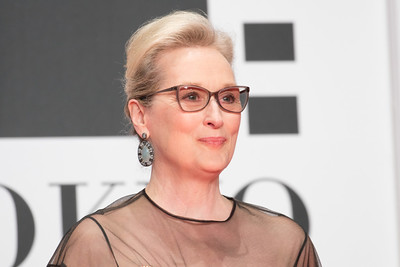
Actress Meryl Streep warned married women could be blocked from voting under a GOP-backed bill she criticized during a televised interview.
Appearing on “The Late Show with Stephen Colbert,” Streep raised concerns about the Safeguarding American Voter Eligibility Act, arguing that women who changed their names could face new hurdles when trying to cast ballots.
She described a scenario in which voters might be required to verify their identity if their current name does not match official documents tied to voter registration records.
“I hope that the Save America Act, if that passes, all the married women that have changed their names are going to have to go to the registrar and prove that they are who they are,” Streep said.
Meryl Streep: The SAVE America Act, if that passes, all the married women that have changed their names are going have to go to the registrar and prove who they are. Otherwise, when you get to the voting booth in November, you might be disqualified, because your name on your… pic.twitter.com/Xxzjb7UBMB
— Headquarters (@HQNewsNow) April 2, 2026
She pointed to potential mismatches between birth certificates and voter rolls, warning that some women could be turned away at polling places if documentation does not align.
“This is what I understand,” she continued. “Otherwise, when you get to the voting booth in November, you might be disqualified because your name doesn’t, on your birth certificate, doesn’t match your name on the voting rolls.”
She whined that the process would be burdensome but urged compliance to avoid being denied a ballot.
“This is such a pain in the neck because you have to go but do it because, otherwise you’ll be turned away,” she told Colbert’s audience.
Streep added that the issue carries wider implications, stressing that “women need to be heard, especially in this moment,” as debates over election procedures intensify ahead of upcoming federal contests.
The remarks came as media figures and legal analysts continued to scrutinize President Trump’s recent executive order on election procedures, as well as his broader criticism of mail-in voting.
.@POTUS signs an Executive Order ordering citizenship verification for federal elections and securing mail-in ballot procedures through the USPS https://t.co/8vCF20svLT pic.twitter.com/5xFJLvpKNR
— Rapid Response 47 (@RapidResponse47) March 31, 2026
Journalist Katie Couric argued the administration’s moves reflect a coordinated effort to influence how elections are conducted while raising pressure on election officials.
Speaking on her “Breaking News” podcast, Couric said the president’s rhetoric and policy steps are part of a “real effort” to interfere in elections and intimidate workers tasked with administering them. She pointed to both public statements and federal directives targeting voting systems.
Brennan Center for Justice director Sean Morales-Doyle, who joined Couric for the discussion, described the executive order as exceeding presidential authority and warned of potential legal consequences for local officials.
He said the message implied by the administration’s actions is that officials who deviate from federal expectations could face prosecution.
🎓Help millions think clearly and communicate with power through Hillsdale College’s free “Classical Logic and Rhetoric course! 🎓 Expand education for liberty and equip the next generation ➡️➡️➡️ TAKE THE FREE COURSE NOW!!! 🇺🇸🇺🇸🇺🇸
“What is implied by Trump’s actions is that if election officials allow anyone who is not on a national list of who can legally vote, then we’re coming for you, and you can worry about being criminally prosecuted,” Morales-Doyle said.
Couric pointed out that the impact the messaging could have on elections. “So, it’s multifaceted,” she said. “It’s really also designed to intimidate and scare election workers.”
Earlier in the conversation, she described the administration’s approach as erratic but pointed to a pattern she believes signals a larger objective.
“These actions seem to indicate a real effort to, excuse my French, but f with our elections,” Couric said, adding that the comment reflected a level of candor she would not use on traditional broadcast platforms.
“And I can say that on Substack, not on network news,” she joked.
Morales-Doyle also outlined the structure of the executive order, explaining that it directs the Department of Homeland Security to assemble a comprehensive list of U.S. citizens across states.
A second component instructs the U.S. Postal Service to limit ballot distribution to individuals included on approved mail-in voting lists, with additional tracking measures built into the process.
“The president tried issuing an executive order to interfere in our elections, rewrite the rules, exactly a year ago,” Morales-Doyle said, referencing a previous effort that required passport documentation for voter registration.
He noted that legal challenges were filed quickly and ultimately blocked that earlier directive before it took effect.
Couric described what she called a “drip, drip, drip” strategy, arguing the cumulative effect is intended to erode public confidence in election systems.
She suggested repeated actions and statements are designed to create uncertainty at scale rather than through a single sweeping change.
Trump has repeatedly defended his position on mail-in voting, arguing it opens the door to fraud despite a lack of widespread evidence supporting that claim.
He has also maintained that undocumented immigrants participate in elections in significant numbers, a claim disputed by election officials and studies examining voter data.
In recent weeks, the president has intensified his criticism as midterm elections approach. At a White House event, he labeled mail-in voting “cheating” while promoting his executive order as a step toward tightening election security.
“The cheating on mail-in voting is legendary,” Trump said. “I think this will help a lot with elections. We’d like to have voter ID, we’d like to have proof of citizenship, and that will be another subject for another time.”
White House staff secretary Will Scharf outlined the administration’s plan, saying federal data would be used to give state officials a clearer view of eligible voters within their jurisdictions.
“We’re going to ensure that each state’s election officials are provided with a comprehensive view of who the eligible voters in their jurisdiction actually are,” Scharf said, adding that the goal is to verify that all participants are legally authorized to vote.
Trump has also elevated the SAVE Act as a top legislative priority, framing it as a necessary measure to secure elections.
The bill would require proof of U.S. citizenship for voter registration in federal contests and mandate identification at polling locations.
“We’re the only country in the world that does it that way. Corrupt as hell,” Trump said during a public appearance, reiterating his long-standing criticism of mail-in ballots while tying the legislation to broader cultural and political issues he has championed.
Democrats have pushed back, warning that the administration’s actions risk undermining access to the ballot box.
Party leaders and affiliated organizations filed a lawsuit seeking to block the executive order, arguing it represents an overreach of presidential authority.
In the complaint, Democratic election lawyer Marc Elias wrote that the order attempts to impose sweeping changes to how absentee and mail-in ballots are handled, changes he said could disenfranchise lawful voters. He argued the administration has repeatedly tried to reshape election rules for political gain.
Senate Minority Leader Chuck Schumer described the executive order as “outlandish” and pointed to past legal battles in which Democrats successfully challenged similar efforts.
“We will see him in court and we will beat him again,” Schumer stated, signaling an extended fight over the future of federal election policy.