
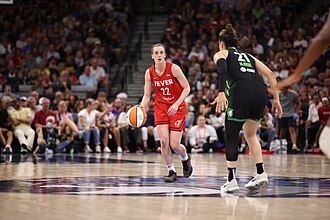
Caitlin Clark gave the WNBA’s hottest culture-war fight as little oxygen as possible when it reached her postgame press conference Sunday.
The Indiana Fever star was pulled into the debate after teammate Sophie Cunningham’s comments on men in women’s sports set off days of backlash, protests, boos, arena drama and league discipline.
She put the policy question with the people who run the sport, not Indiana’s locker room.
“I think it’s for leagues and governing bodies to work with their athletes and find solutions, but our focus is on basketball. That’s what we talk about,” Clark said.
Caitlin Clark dodges question on protecting women's sports.
"It's for the leagues and governing bodies to work with their athletes to find solutions." pic.twitter.com/LZSx91D4XX
— Jackson Thompson (@JackThompsonFOX) August 2, 2026
A follow-up about Cunningham got the same boundary. “I just answered for you,” Clark said.
Cunningham’s original answer came in an ESPN profile last month, when she was pressed on where she stood in the debate over men in women’s sports.
Asked about the issue, Cunningham framed her answer around young athletes and locker rooms.
🎓Help millions think clearly and communicate with power through Hillsdale College’s free “Classical Logic and Rhetoric course! 🎓 Expand education for liberty and equip the next generation ➡️➡️➡️ TAKE THE FREE COURSE NOW!!! 🇺🇸🇺🇸🇺🇸
“I want to protect young girls in a locker room, or young girls in sport who shouldn’t have to go against biological men,” she said in the profile.
After the criticism hit online, Cunningham did not walk it back. “I said what I said,” she remarked.
The controversy has trailed Indiana through multiple stops.
In Portland on Friday night, Cunningham heard it from the home crowd after her position on transgender athletes in women’s sports drew anger.
After hitting a three-pointer, she denied making the “losers” hand signal some viewers believed they saw, but acknowledged she fired back at the crowd.
Sharing video of the moment afterward, Cunningham offered her own version of what happened.
“I didn’t call them losers but I did talk s***,” she wrote.
She also posted a clip of herself holding a finger to her lips, appearing to quiet the boos.
Outside Moda Center before that game, supporters from the Women Are Real group demonstrated for Cunningham’s position.
The crowd appeared small, and Cunningham distanced herself from organizing it.
“I have honestly had nothing to do with them,” Cunningham told reporters.
Still, she defended the group’s right to be there, saying fans have been making themselves heard around the WNBA for years.
“Props to them,” Cunningham said, praising people “who are able to be competent and be bold and courageous enough to speak their truths.”
The same group had already drawn attention in Seattle days earlier after two 16-year-old female Cunningham supporters said they were confronted courtside by Storm co-owner Celeste Keaton.
The teens were wearing gear supporting Cunningham’s position when Keaton reportedly launched an expletive-laced tirade at them.
The WNBA later banned Keaton from the Storm’s next five home games after she allegedly told the young supporters they were “f***ing insane.”
Cunningham has also rejected the idea that the firestorm has followed her into the Fever’s locker room.
“I think at the end of the day, I come in and I do my job,” Cunningham said before Friday’s game.
She described herself as loving basketball, her teammates and the chance to inspire young fans, while saying the outside noise had not become a team distraction.
“I love inspiring the next generation and doing that in a positive light,” Cunningham said.
She said the controversy did not cross her mind or her teammates’ minds.
Cunningham also made clear she would not shrink herself to make critics more comfortable.
“And again, I’m here to play basketball,” she said, adding that she was also there to be herself and would not “dim my light just because maybe people don´t agree with that.”
Fever coach Stephanie White was more cautious when the transgender-athlete debate reached her before tipoff Friday.
White said she did not consider herself scientifically prepared to settle the question of biological males in women’s sports, but she rejected exclusion as an answer.
“I wouldn’t say I’m educated enough from a scientific standpoint, but I don’t ever believe that exclusion is an answer,” White said. “I just don’t.”
She also pointed to the different levels and governing bodies within sports, then recalled that she grew up playing with boys because girls sports were not available to her then.
Minnesota Lynx coach Cheryl Reeve challenged the way the locker-room argument has been framed.
“It is not the case that we have, quote, biological men in girls’ locker rooms,” Reeve said, arguing that the phrasing carried “the innuendo there that somehow transgender women are predators of some kind in the locker room.”
Reeve pushed for inclusion and said “exclusion is not the answer.”
A day later, Cunningham and Reeve crossed paths at center court before the game. The meeting appeared cordial despite the heated public fight around the issue.
Brittney Griner’s marriage also became part of the WNBA news cycle this week.
The former Atlanta Dream player filed for divorce from wife Cherelle Griner on Thursday in Georgia’s Fulton County, according to the Atlanta Journal-Constitution.
The Griners married in 2018 and have a 2-year-old son. In court documents, Brittney Griner listed July 24 as the date of separation and described the marriage as “irretrievably broken.”
Cherelle, an attorney, became one of Griner’s public advocates after the WNBA All-Star was detained in Russia in February 2022. Russian authorities had found vape cartridges containing cannabis oil in her luggage.
Griner was charged with smuggling “narcotic drugs” into Russia and later sentenced to nine years in a Russian penal colony.
She was freed in December 2022 through a U.S.-Russia prisoner swap.